


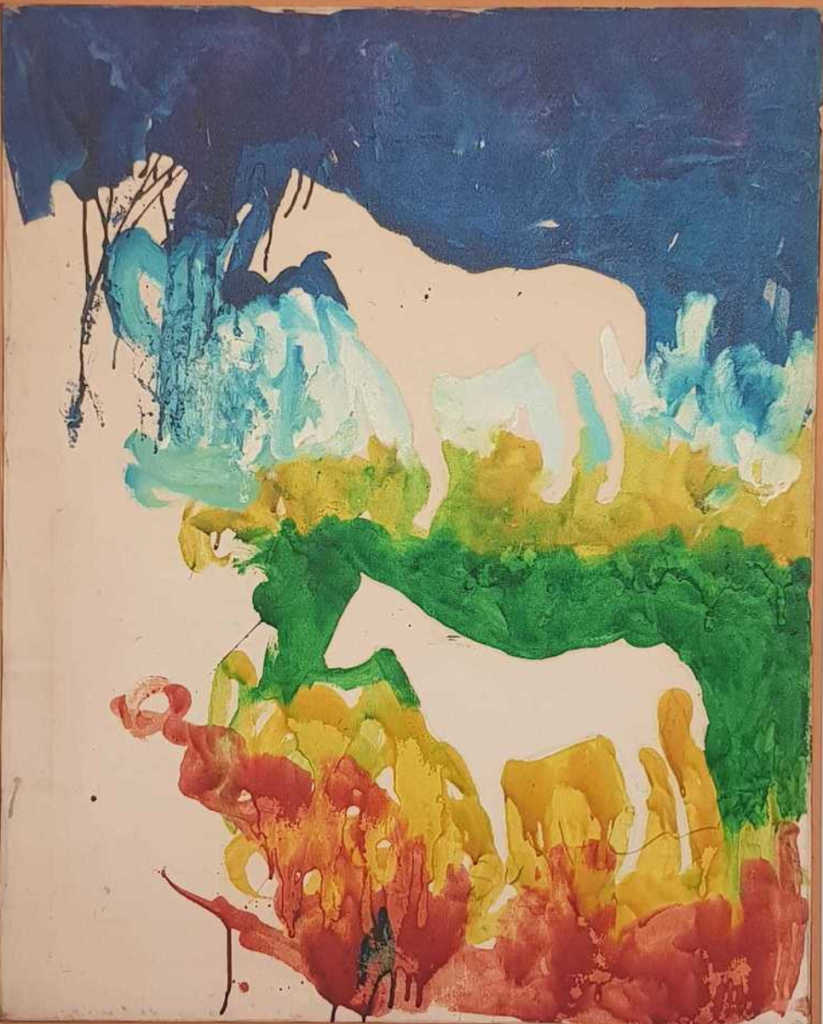

Whomever lays eyes for the first time on a Schifano artwork is instantly struck by how well painting, industrial materials and photography mix together on a custom size canvas.
Be it a monochrome, the advertising details in pop-art key from the roaring ’60s, the thick photographic gel and paint layers that feature bicycles or boats, the paesaggi anemici or the in mass production of his late years : each of them offer a glimpse of Schifano and his way of seeing the world and interacting with it.
He was famous for being the focal point of social life in Rome without even leaving the house. Also, without stepping foot outside his front door, he would know everything that was going on in the world; you name it: cycling contests, politics, music, cinema, adult programs – everything was under control from his “wall made of TVs”. That’s how, even if not allowed to travel, Schifano was always in the loop.
He also had a huge passion for Polaroids, It is said to have made mountains of photos, of everything surrounding him and especially of something that would catch his eye on TV.
He was a very prolific artist, capable of creating dozens of paintings in one night but also rather difficult to be dealt with by the gallerists, commissioners and collectionists due to his moments of inactivity.
Many describe him as a pop artist, but the truth is that he went beyond pop-art. His figurative-advertising-space-color-quality and quantity-cinematographic way of approaching a canvas is more than simply stamp and stencil, drip and paint.
Perhaps the feeling of homecoming one gets upon gazing a Schifano palm tree or stars or horses is what he had in mind, the romantic rediscovery of the traditional painting as a technique …but in a modern key.
⇣Italian translation ⇣


Chiunque posi gli occhi per la prima volta su un’opera d’arte di Schifano rimane immediatamente colpito da quanto bene la pittura, i materiali industriali e la fotografia si mescolino insieme su una tela di dimensioni personalizzate.
Che si tratti di un monocromo, i dettagli pubblicitari in chiave pop-art dei ruggenti anni ’60, gli spessi gel fotografici e strati di vernice che caratterizzano biciclette o barche, i paesaggi anemici o la produzione in serie dei suoi ultimi anni: ognuno di loro offre una scorcio di Schifano e del suo modo di vedere il mondo e di interagire con esso.
Era famoso per essere stato il punto focale della vita sociale a Roma senza nemmeno uscire di casa. Inoltre, senza mettere piede fuori dalla porta di casa, avrebbe saputo tutto quello che stava succedendo nel mondo; lo chiami tu: gare di ciclismo, politica, musica, cinema, programmi per adulti – tutto era sotto controllo dal suo “muro di TV”. È così che, anche se non autorizzato a viaggiare, Schifano è sempre stato nel giro.
Aveva anche una grande passione per le Polaroid, si dice che abbia realizzato montagne di foto, di tutto ciò che lo circonda e soprattutto di qualcosa che avrebbe attirato la sua attenzione in TV.
Era un artista molto prolifico, capace di realizzare decine di dipinti in una notte ma anche piuttosto difficile da trattare da galleristi, committenti e collezionisti a causa dei suoi momenti di inattività.
Molti lo descrivono come un artista pop, ma la verità è che è andato oltre la pop-art. Il suo modo figurativo-pubblicitario-spaziale-colore-qualità e quantità-cinematografico di avvicinarsi a una tela è più che un semplice timbro e stencil, gocciolamento e pittura.
Forse la sensazione di tornare a casa che si prova osservando una palma di Schifano o delle stelle o dei cavalli è quello che aveva in mente, la romantica riscoperta della pittura tradizionale come tecnica … ma in chiave moderna.
 Luma Arte Contemporanea