
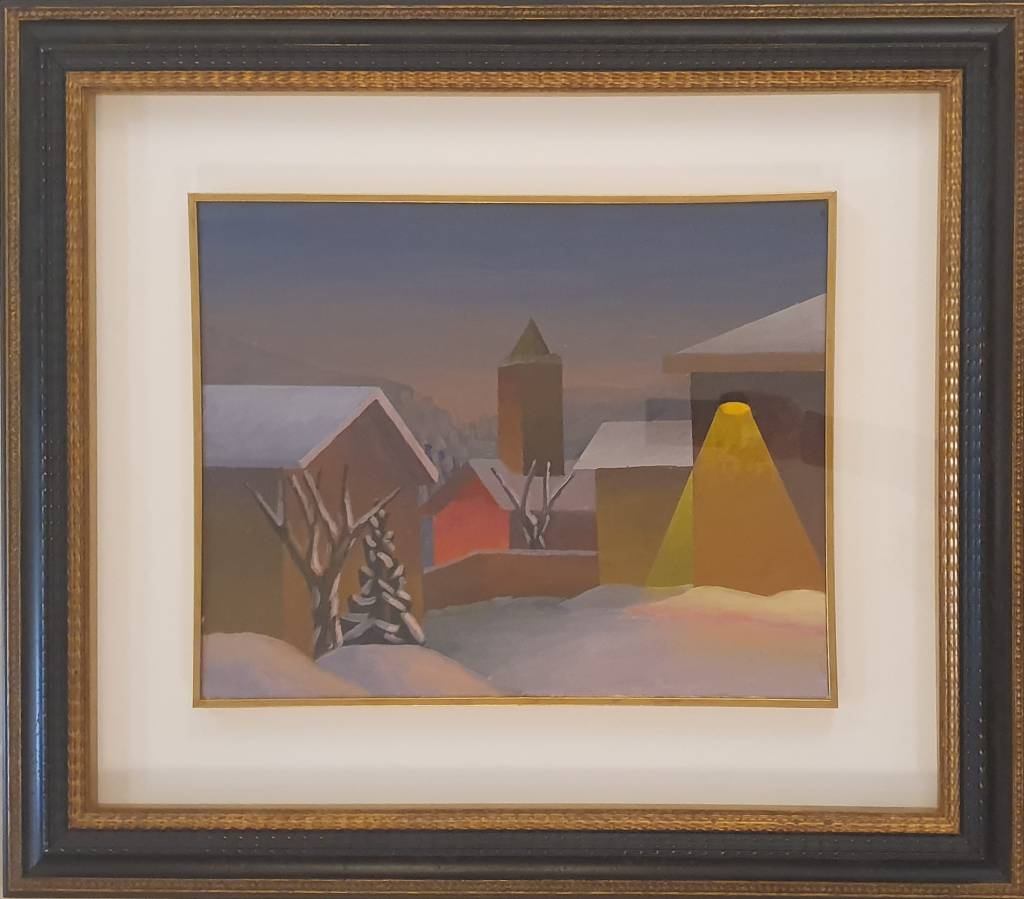
The aparent ingenuity of Salvo is given by his apprehension of simplicity without reflecting a maestro who has learned to elude complexity. Behind the simplifications present in his painting lies an analytic conscience of the past, a silent knowledge fueled by the unwinding roots of tradition.
He manages to use in our modern times absolute classical methods in order to attract a contemporary eye and yet remain in the figurative field. His painting is precise, of realist inspiration; the colors are lit and the lightness of the outcome brings to mind a bit of Rousseau’s ingenuity combined with the discipline of de Chirico.
From the end of the ’60s Salvo’s work expresses clearly the soulsearching, the narcisistic complacency, the link to history and culture. An indication of his future developement as an ‘arte povera’ artist can be found in his photographic works and in his marble panels engraved with writings such as ‘Idiota’, ‘Respirare il padre’, ‘Io sono il migliore’.
The great shift happens in 1973, when he redescovers painting, being one of the first ‘artisti poveri’ to return to the roots of pure artistic and figurative expression. He elaborates landscapes inspired by real cities or ruins( like Sicily, Greece, Turkey) and grants them a simplified design accompanied by vibrant, lively colors.
 Luma Arte Contemporanea